VO2 Max: How Wearables Estimate It and Improve in 8–12 Weeks

VO2 max is the maximum amount of oxygen your body can take in, transport, and use during intense exercise, and it’s the most widely accepted marker of aerobic fitness. It’s measured either as an absolute value (liters per minute) or, more usefully for comparing people, as a relative value in milliliters per kilogram per minute. A higher number generally means better cardiovascular endurance and gives you a real benchmark to track as you train.
TL;DR:
Training with high-intensity interval sessions and consistent moderate efforts over 8 to 12 weeks reliably improves VO2 max, especially when gradually increasing workload.
Wearable estimates of VO2 max should be tracked as trends over weeks rather than reacting to day-to-day fluctuations, and they work best when using the same device and protocol.
VO2 max trends lower with age starting after your 30s, but regular aerobic activity can slow this drop and improve overall cardiovascular health.
Absolute VO2 max reflects total oxygen capacity, but most fitness comparisons focus on relative VO2 max, which adjusts for body weight and is more meaningful.
Comparing test results across modalities or with changing devices introduces measurement noise; interpret small fluctuations cautiously and focus on long-term trends.
Table of Contents
What Does VO2 Max Actually Measure?
Your VO2 max reflects two things working together: how well your body delivers oxygen, and how well your muscles use it once it arrives. The delivery side depends on cardiac output (how much blood your heart pumps) and how efficiently your lungs and blood transport oxygen to working muscle. The usage side depends on mitochondrial density and how efficiently muscle cells convert oxygen into energy.
Reporting matters here. Absolute VO2 max, in liters per minute, reflects total aerobic capacity, while relative VO2 max, in mL/kg/min, adjusts for body weight and is what most fitness comparisons actually use.
A few factors shape where you land on that scale:
-
Genetics account for a large share of the variation between individuals, even with identical training.
-
Age brings a gradual drop in VO2 max, typically starting in your 30s.
-
Sex differences exist too, largely tied to differences in body composition and hemoglobin levels.
None of these factors are fixed in stone. Training moves the needle regardless of your starting point.
How Is VO2 Max Measured?
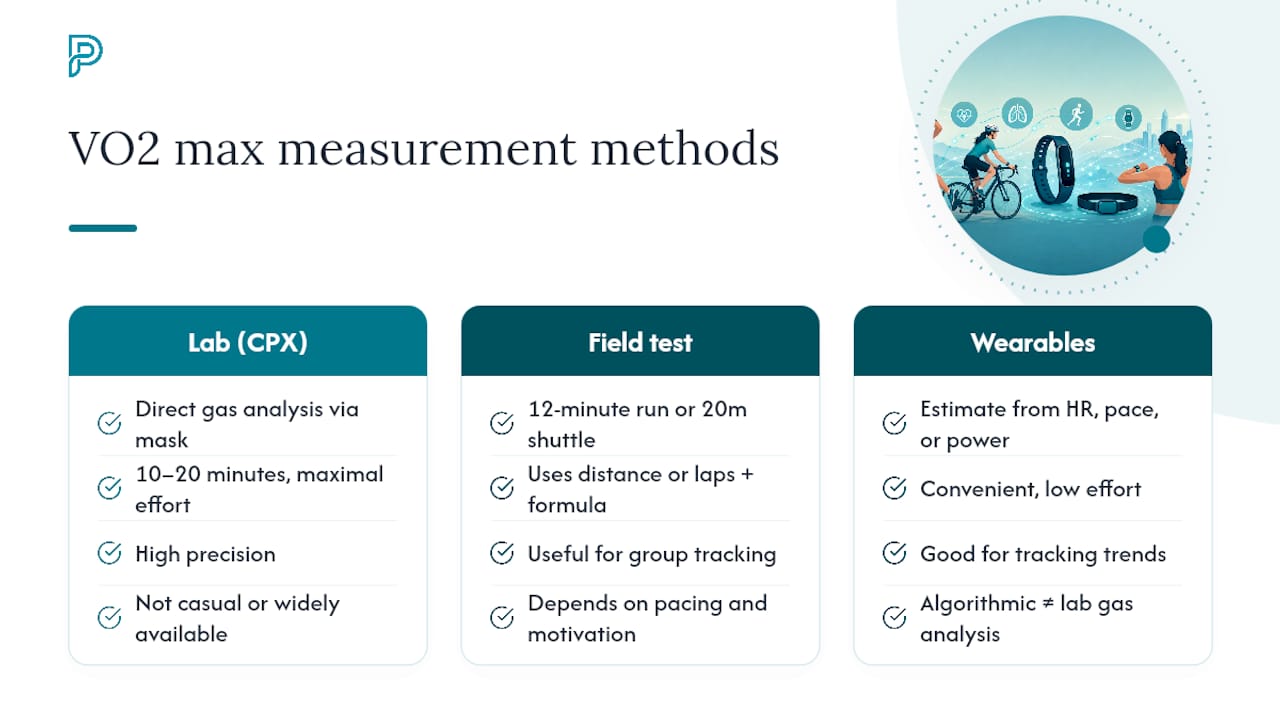
The gold standard is a graded exercise test, sometimes called a CPX test, performed in a lab or exercise physiology clinic. You run or cycle at increasing intensity while wearing a mask connected to a gas analyzer that measures how much oxygen you consume and carbon dioxide you produce. These tests typically run 10 to 20 minutes and ramp up to your maximal effort, which makes them precise but not something most people do casually.
Field tests offer a more accessible substitute. The 12-minute run test and the 20-meter shuttle run both estimate VO2 max using distance covered or laps completed, plugged into a formula. They’re useful for tracking fitness in groups or without equipment, but they depend heavily on pacing strategy and motivation, which introduces error.
Wearables take a third approach, estimating VO2 max from heart rate response during exercise, pace, or power output. They’re convenient and reasonable for tracking trends, but algorithmic estimates aren’t equivalent to lab gas-analysis testing. The single biggest mistake people make is switching devices or protocols mid-tracking and assuming the number change reflects fitness change.
Pro Tip: If you’re tracking VO2 max over months, stick with one device and one test protocol. Comparing a treadmill lab test to a wrist-based estimate will give you noise, not insight.
Choose a lab test if you want precision for medical or elite performance decisions. Choose a field test or wearable estimate if you’re tracking general fitness trends over time and want something repeatable and low effort.
What Does VO2 Max Mean for Your Health?
A higher VO2 max is linked to lower risk of cardiovascular disease and lower all-cause mortality. Harvard Health notes that cardiorespiratory fitness, quantified through VO2 max, correlates with reduced chronic disease risk and serves as a useful benchmark for tracking fitness over time. Major health bodies increasingly treat cardiorespiratory fitness as a vital sign worth monitoring, not just a performance number for athletes.
For endurance athletes, VO2 max plays a more tactical role. It helps set training zones, gauge whether a training block is working, and flag when progress has plateaued.
A few ways people put the number to use:
-
Endurance athletes use VO2 max trends to calibrate training intensity across a season.
-
Coaches use repeat testing to check whether a specific training block improved aerobic capacity.
-
Health-conscious adults use it as one more signal alongside resting heart rate, blood pressure, and body composition.
That last point matters. VO2 max is a strong signal, but it’s one piece of a larger picture. Pair it with how you’re recovering, sleeping, and feeling day to day rather than treating it as a standalone verdict on your health.
What Counts as a Good VO2 Max?
There’s no single number that qualifies as “good” for everyone. Context matters more than any threshold. Broadly, inactive adults often score in the low 20s (mL/kg/min), recreationally active people often land in the 40s, and elite endurance athletes commonly exceed 70.
A few things to keep in mind when interpreting your own score:
-
VO2 max trends lower gradually with age, so a 45-year-old’s “good” number looks different from a 25-year-old’s.
-
Men typically post higher relative VO2 max values than women, largely due to differences in body composition and hemoglobin concentration.
-
Percentile calculators based on age and sex, like those built on ACSM fitness classification standards, give you a more honest comparison than a flat number ever will.
The most useful frame isn’t “is my number good?” It’s “is my number moving in the right direction compared to where I started?”
How Can You Improve Your VO2 Max?
VO2 max responds well to training, and the research points to a few approaches that consistently work.
-
Add high-intensity interval training (HIIT). Short bursts of near-maximal effort, like 4 minutes hard followed by 3 to 4 minutes easy, repeated for several rounds, are one of the most time-efficient ways to raise VO2 max.
-
Build a base with moderate-intensity continuous training (MICT). Steady efforts at a conversational pace, sustained for 30 to 60 minutes, build the aerobic foundation that HIIT sessions build on top of.
-
Apply progressive overload. Gradually increasing duration, intensity, or frequency over weeks forces adaptation instead of a plateau.
-
Manage body composition. Since VO2 max is typically expressed relative to body weight, changes in body composition can shift your relative number even without a change in absolute oxygen uptake.
-
Prioritize recovery and consistency. Aerobic adaptations happen between sessions, not during them, so adequate sleep and spacing between hard efforts matter as much as the workouts themselves.
Pro Tip: You don’t need five hard sessions a week to see change. Two focused interval sessions plus two to three easier aerobic sessions, sustained consistently for 8 to 12 weeks, tends to move VO2 max more reliably than sporadic all-out efforts.
How Should You Track VO2 Max With Wearables and Other Data?
Wearable VO2 max estimates typically come from heart rate response paired with pace or power output during your workouts. They’re convenient, but they carry real limitations: sweat, strap placement, heart rate drift from heat or caffeine, and algorithm differences between brands can all shift the number without reflecting a true fitness change.
The more reliable approach is watching trends over weeks, not single readings, and putting that trend in context alongside other signals.
-
Track VO2 max estimates over 6 to 12 week windows rather than reacting to day-to-day fluctuations.
-
Cross-check rising or falling VO2 trends against sleep quality and HRV, since poor recovery can suppress performance and skew estimates.
-
Look at training load alongside VO2 trends to see whether harder blocks are actually translating into fitness gains.
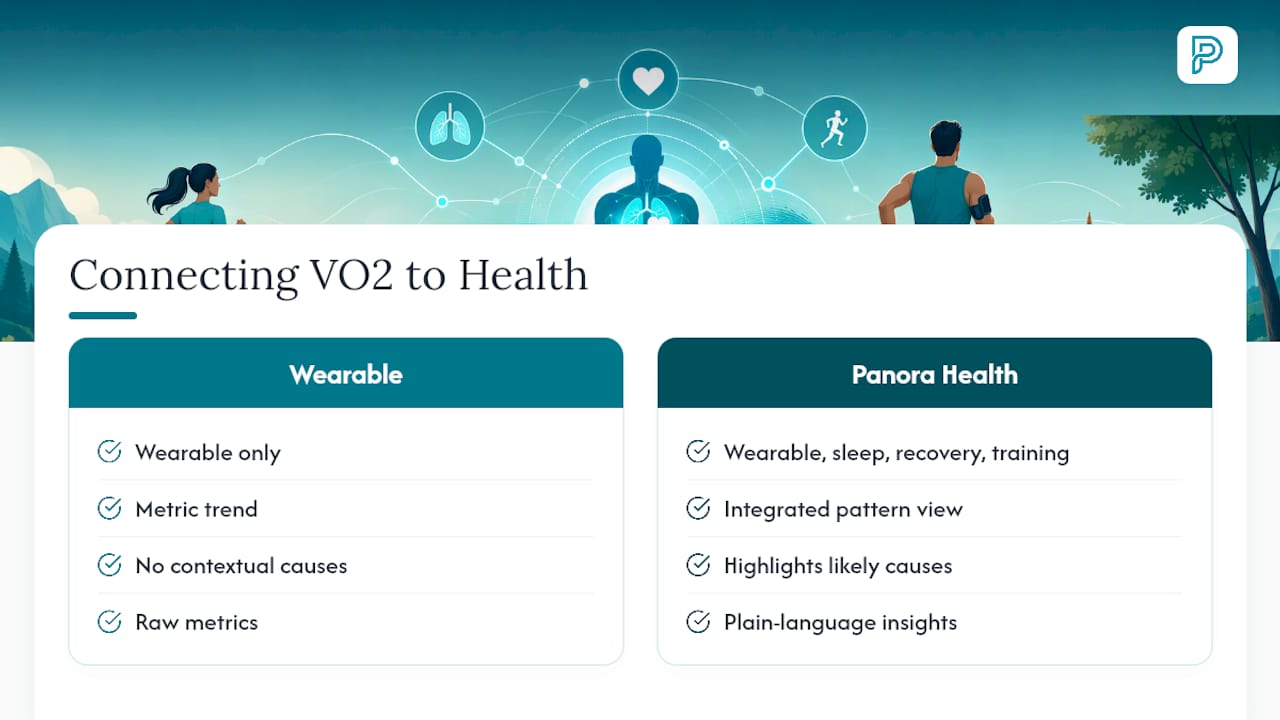
This is where a consolidated view helps. Some health platforms pull in wearable, sleep, and training data so you can see whether a VO2 max shift lines up with a real change in recovery and workload, without needing to cross-reference three separate apps. It doesn’t diagnose or interpret medical significance. It just puts the picture together.
What Are the Limits of VO2 Max Testing?
Test modality changes your number. Treadmill tests typically produce higher VO2 max values than cycling tests in untrained people, because running recruits more total muscle mass, so comparing scores across modalities is misleading.
Day-to-day variability is real too. Hydration, sleep, caffeine, and even ambient temperature can shift a test result. As a rule, changes under roughly 3 to 5% are often just measurement noise rather than genuine physiological change, so don’t overreact to small swings.
One more distinction worth knowing: VO2 peak refers to the highest oxygen uptake reached during a test, while true VO2 max requires a plateau in oxygen consumption despite increasing workload. Many field and wearable estimates are really measuring VO2 peak.
A Simpler Way to Connect Your VO2 Data to the Rest of Your Health
Your wearable can tell you your VO2 max trend is climbing or dropping, but it can’t tell you why on its own. Panora Health is a different route to that answer: an app that connects your wearable data, sleep, recovery, and training logs into one place, so a VO2 max dip shows up next to the poor sleep week or the heavy training block that likely explains it. Instead of toggling between your watch app, a sleep tracker, and your own memory of how the week went, you get the pattern laid out in plain language.
Panora Health doesn’t diagnose or replace a clinician’s read on your data. It’s built for people who want to understand their own numbers without needing a sports science background. If you’re already logging workouts and wearable data and want it to actually mean something, check out Panora Health and see how your VO2 trends connect to the rest of your health picture.
This article is general information, not a substitute for advice from a qualified doctor. Consult a qualified healthcare professional about your own circumstances before acting on anything here.
Sources
-
VO2 max: What is it and how can you improve it? - Harvard Health
-
Mayo Clinic Q&A: What does a VO2 max have to do with overall fitness? - Mayo Clinic News Network
FAQ
What Is a Normal VO2 Max Score?
There’s no single “normal” score since it depends heavily on age, sex, and training status. Inactive adults often fall in the low 20s (mL/kg/min), recreationally active people often reach the 40s, and elite athletes commonly exceed 70. Percentile calculators based on age and sex give a more accurate read than comparing to a flat benchmark.
How Accurate Are Wearable VO2 Max Estimates?
Wearables can give a reasonable estimate for tracking trends, but they aren’t equivalent to a lab-based gas-analysis test. The value comes from consistency: using the same device and conditions over time matters more than any single reading.
Can You Really Improve Your VO2 Max?
Yes. HIIT and moderate-intensity continuous training both improve VO2 max, with progressive overload and consistent recovery driving the biggest gains. Most people see measurable change over 8 to 12 weeks of structured training.
Does VO2 Max Drop With Age?
Yes, VO2 max trends lower gradually starting around your 30s, though the rate of change varies with training status and body composition. Staying aerobically active slows that drop compared to a sedentary lifestyle.
Recommended
-
HRV Explained: What Your WHOOP Recovery Score Is Actually Telling You
-
The Sleep-Recovery Connection: Why Duration Isn’t Everything
-
Why Your Blood Work, Sleep, and Nutrition Are More Connected Than You Think
This article is educational general-wellness information, not medical advice. Panora Health is a General Wellness product, not a medical device. Discuss your own lab results and health questions with a qualified clinician.
Panora Health AI provides wellness information, not medical advice. This is not a substitute for professional medical diagnosis or treatment. Always consult a qualified healthcare provider before making health decisions.